

Alternate history is a term readers and writers will often come across as a sub-genre. It is a sub-genre that fascinates me and I often incorporate this into my writing. But what really does writing “alternate history” really involve?
A new guide by AUS author Jack Dann The Fiction Writer’s Guide to Alternate History does a fantastic job in untangling this subject.
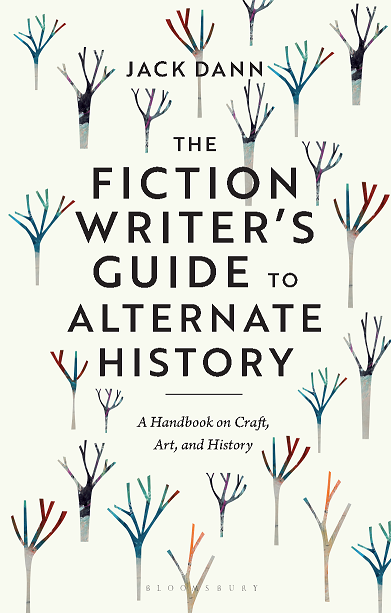
Dann prefers the term “counterfactual fiction” and defines it as the following:
Counterfactual fiction is generally defined by its relation to history, and it comes into being through the writer’s choice of a “divergence point,” an alteration which creates a new branch of history that confounds or rejects the “real” history we think we know.”
Jack Dann, A Fiction Writer’s Guide to Alternate History, p. 3.
Dann continues to describe this point at which a writer chooses to diverge from the real or known history and create something new from thereafter as divergence points, nexus points or an invented or inverted discrete historical point. So, for writing what does this look like practically? Dann provides a suitable definition for what counterfactual fiction entails:
1. Counterfactual fiction is basically a narrative in which an invented or inverted discrete historical event catalyses a new and different sequence of subsequent events that changes the course of history as we know it.
2. A counterfactual fiction must, then, in some way hinge on a divergence from known history, whether it be in the near or the distant past.
– Jack Dann, A Fiction Writer’s Guide to Alternate History, p. 5
In practice of writing an alternate history, most of the sub-genre owes its origins to science fiction. I have, personally, never considered my writing in the genre of science fiction but, it must at some point, share connections with time travel, parallel worlds and historical fantasy.
In The Fiction Writer’s Guide to Alternate History, Dann provides a useful overview of how to aid the reader when the history they know diverges into something new and unfamiliar. Dann calls the solutions to these issues the ‘counterfactual toolbox.’
1. Choosing a divergent point that the average reader can recognise.
2. An acute mindfulness on the part of the writer regarding the historical knowledge of the reader.
3. Employing paratextual elements, including forewords, afterwords, chapter quotes, character and place listings, maps, and the insertion of fictional documents including letters, newspapers, and advertisements.
4. Describing familiar places and characters which may have different characteristics and functions in the counterfactual story world.
5. Implementing the technique of Heinleining, which involves providing concise but necessary details in the form of clues without distorting the narrative. Indeed, it is hoped that decoding the clues becomes part of the pleasure provided by the work.
– Jack Dann, A Fiction Writer’s Guide to Alternate History, p. 51.
Dann further provides a useful Roundtable Q & A with authors of alternate history including John Brimmingham, Charmaine Harris, Richard Harland and the late Mary Rosenblum. Dann provides some ‘rules’ for creating alternate history texts based on Shippey that counterfactual fiction “should be (1) plausible, (2) definite, (3) small in itself, and (4) massive in consequence.”
These tactics are broken down into the following concepts:
a) Counterfactual fiction is defined by its relation to history and comes into being through the practitioner’s choice of divergence point.
b) The author’s research into historical texts not only drives narrative, but creates narrative.
c) The story world that emerges from the author’s historical research and subsequent creation and extrapolation of narrative can function as a character itself to drive action.
d) These invented story worlds are brought to life by a technique that I’ll refer to as “layering”.
– Jack Dann, A Fiction Writer’s Guide to Alternate History, p. 56
In my own writing and experimentation with alternate history, these have been the baseline of my own creative toolbox to develop a story that emerges from a small point in real history to develop a new and functional narrative. My own works that have explored this include “The Devil and the Loch Ard Gorge”, my novella Bluebells and several works in Three Curses and Other Dark Tales as well as current works-in-progress exploring the European Victorian era and 1920s Australian history. All my works incorporate a layering of a supernatural world alongside the “known” historical world with the divergence points being, at some stage or other, the bleeding of that supernatural world into the historical where both become the alternate history.
Particularly recommended works on alternate history include Richard Harland’s The Ferren Trilogy, Lee Murray’s Despatches, Charlaine Harris’ Sookie Stackhouse series, Heather Fawcett’s Emily Wilde series, Mackenzi Lee’s The Montague Siblings series, Emily Tsech’s The Greenhollow Duology and P. Djèlí Clark’s The Dead Djinn Universe.
 Leanbh Pearson