
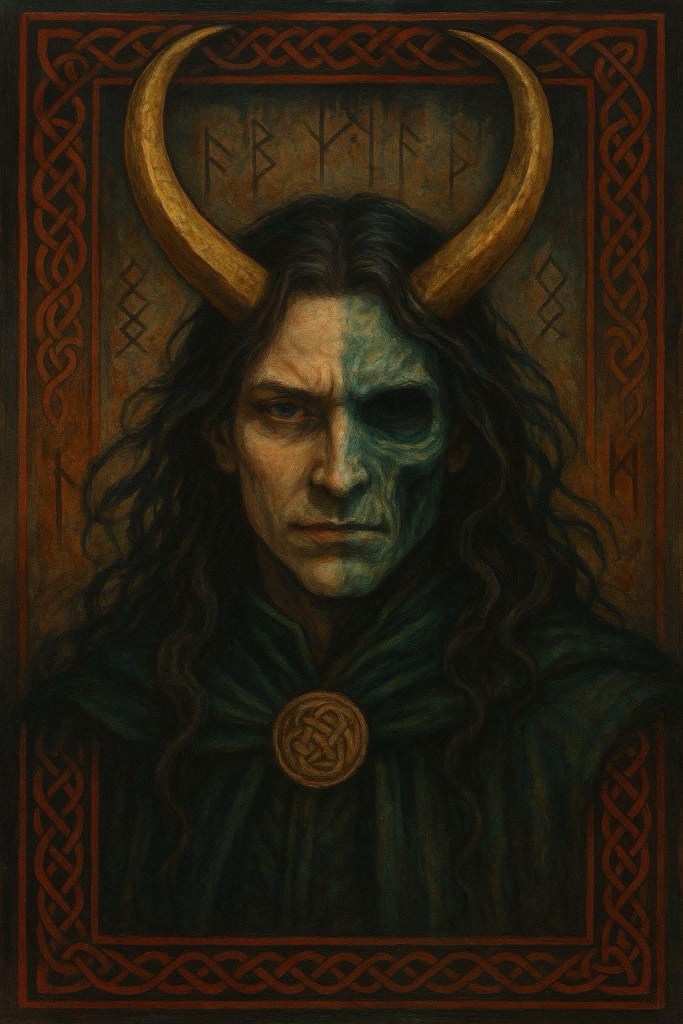
Who is Loki?
Loki is a trickster god—not evil by default, but disruptive by nature. He is clever, sharp-tongued, and endlessly adaptable. Born a jötunn (giant), he becomes blood-brother to Odin, which grants him a place among the Æsir gods despite never fully belonging.
That tension—insider and outsider at once—defines him.
What does Loki Represent?
- Change & Chaos – He breaks stagnant order so something new can emerge
- Shapeshifting & Identity – Loki changes form and gender freely (mare, salmon, fly, old woman), defying boundaries
- Truth Through Disruption: He exposes hypocrisy and weakness, often painfully
- Cunning Intelligence – Words are his weapons; wit is his magic
Loki in Myths
- He fathers powerful beings: Fenrir (the wolf of destruction), Jörmungandr (the world serpent), Hel (ruler of the dead).
He also gives birth most famously to Sleipnir, Odin’s eight-legged horse - He is responsible for extraordinary gifts to the gods (like Odin’s spear and Thor’s hammer), gained through dangerous bargains
- He causes trouble, then often fixes it—sometimes only because he must.
- He Orchestrates the death of Baldr, the most beloved god and son of Odin.
- Bound beneath the earth with a snake dripping venom onto his face
Loki and Ragnarok
- In Ragnarök, Loki breaks free and fights against the gods. This is not betrayal in the human sense—it is fulfillment of destiny. Loki becomes the necessary antagonist to end one cosmic cycle so another can begin.
Without Loki, there is no ending. Without endings, there is no rebirth. Loki is the balance between chaos and order.
Source: The Crones Grove 🌙🌑

