

⭐️⭐️⭐️⭐️
Description
The Dark Grace is dead.
Feared and despised for the sinister power in her veins, Alyce has spent 100 years wreaking her revenge on the kingdom that made her an outcast. Once a realm of decadence and beauty, Briar is now wholly Alyce’s wicked domain. No one escapes the consequences of her wrath.
Not even the one person who holds her heart.
Princess Aurora saw through Alyce’s thorny facade, earning a love that promised the dawn of a new age. But that love came with a heavy price: Aurora now sleeps under a curse that even Alyce’s vast power cannot seem to break, and their dream of the world they would have built together is nothing but ash.
Alyce vows to do anything to wake the woman she loves, even if it means descending into the monster Briar believed her to be. But could Aurora ever love the villain Alyce has become?
Or is true love only for fairy tales?
Summary
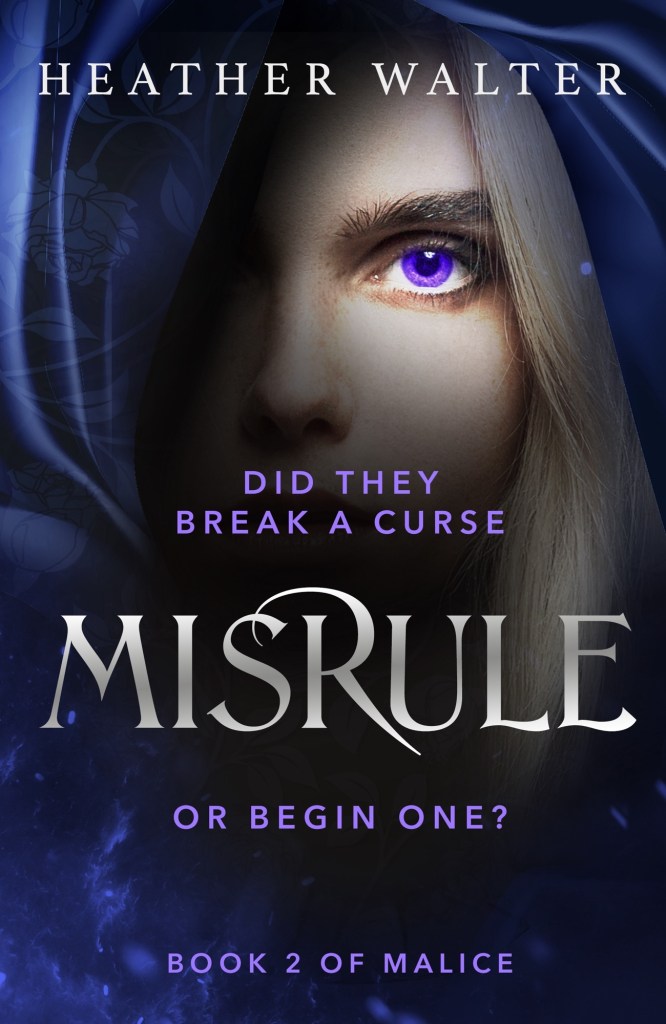
I read Misrule (Malice Duology, #2) the concluding sequel to Malice, in this sapphic fairytale reimagining by fantasy author Heather Walter.
Review
Misrule is an ambitious and emotionally charged conclusion to her dark reimagining of the ‘Sleeping Beauty’ fairy tale. Walter uses the foundations in Malice and expands them into a much larger story of political conflict, shifting loyalties, betrayal and the consequences of choosing revenge over forgiveness.
The protagonist, Alyce remains the most complex and emotionally-rich character. The transformation from persecuted outcast to powerful ruler is well-crafted especially as Walter makes her angry, ruthless but still vulnerable. The frequently contradictory natures, make her desire to protect those who have been rejected by society admirable, but her willingness to inflict suffering in pursuit of these goals also makes her a genuinely morally challenging character.
The relationship between Alyce and Aurora provides the emotional foundation of the story. Their love is tested not simply by the passage of time but by the choices Alyce has made in Aurora’s absence. Walter explores the uncomfortable reality that loving someone does not necessarily mean accepting everything they have become. Their relationship feels far more complicated than the traditional fairy-tale romance, giving the familiar Sleeping Beauty narrative a welcome emotional depth.
Walter creates a layered and expanded world building delving into mythology of the Fae, the darker magical creatures and revealing a world-shattering falsehood in the kingdom. Alyce creates the Dark Court, an exploration of belonging and prejudice while asking if a society can truly be better while relying on the same foundations of oppression.
Throughout the Malice Duology, there has been a political intrigue which adds considerable scale to the narrative to move it beyond the personal conflict between Alyce and Aurora to explore the consequences of their actions across the wider magical world. Here, court politics, competing loyalties, and the threat of war provide plenty of tension and Walter handles many threads throughout the narrative.
Perhaps what Misrule does best is refuse to present love as an easy solution to the cruelty, trauma or the abuse of power that Alyce and Aurora have endured. Walter makes it clear that forgiveness requires more than declarations of devotion in a fairytale-style romance and that improving relationships involves confronting the consequences of one’s actions. This aspect of earning forgiveness and love – albeit never the same again – gives Misrule a mature fairy tale retelling. While the conclusion may not satisfy every reader, particularly those hoping for a straightforward romantic reunion between Aurora and Alyce, the conclusion is consistent with the complicated characters.
Conclusion
Misrule is a dark and layered conclusion to the Malice Duology. Walter takes the familiar Sleeping Beauty story and transforms it into something complex, exploring the blurred boundaries between villain and hero, the consequences of revenge, and the difficult balance between strength and power.
Perfect for readers who enjoy dark fairy tale retellings, sapphic fiction, morally grey protagonists, political intrigue. Misrule delivers a compelling conclusion and closure.
** This is my personal opinion and does not reflect any judging decisions **

