
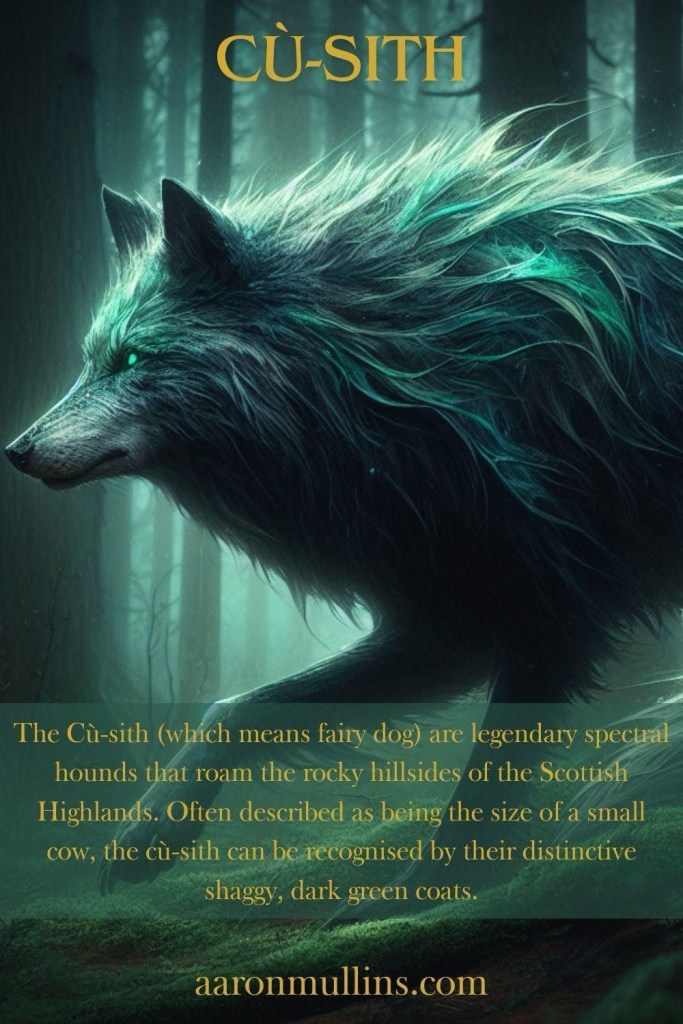
The Cù-Sìth (pronounced koo-shee), a legendary fairy hound from Scottish Highland folklore — and it’s actually a very faithful, atmospheric portrayal.
What is the Cù-Sìth?
• The name literally means “fairy dog” (cù = hound, sìth = fairy / otherworld).
• It is not just a magical animal — it’s a liminal being, halfway between:
• the fairy realm
• the land of the dead
• and the wild places of Scotland
In many traditions, the Cù-Sìth is associated with the Sìthichean (the fae), not as a pet, but as a guardian, hunter, and herald.
Appearance:
The Cù-Sìth is described as:
• Enormous — as big as a small cow or calf
• Shaggy, with long, tangled fur
• Dark green or black in color (green being a strong fae marker)
• Glowing eyes, often described as unnatural or spectral
Role in folklore:
The Cù-Sìth is most often described as:
• A guardian of fairy territories
• A boundary-keeper between worlds
• A death-herald in some stories
One of its most famous traits:
• It lets out three terrifying barks that can be heard for miles.
• After the third bark, anyone who hears it must reach safety — or risk being taken into the Otherworld.
This places the Cù-Sìth firmly in psychopomp territory (a guide or enforcer at the threshold between life and death).
Is it evil? No — but it is not friendly either.
The Cù-Sìth is often an antagonist to humans by:
• It enforces boundaries
• It punishes trespass
• It protects what is not meant for humans
Like many ancient beings, it reflects natural law, not human laws and ideals.
Deeper symbolism
On a symbolic level, the Cù-Sìth represents:
• The wild that cannot be tamed
• The call of the liminal path
• The warning that some doors are not meant to be opened casually
It often appears in stories where someone:
• strays from the path
• walks at twilight
• crosses into forbidden land
• or ignores ancestral warnings
Why it resonates with witchcraft?
The Cù-Sìth is often linked to:
• hedge witches
• night walkers
• ancestral guardians
• those who work between worlds
The Cù-Sìth doesn’t follow gods or humans — it answers to older, natural laws.
In summary:
• The image shows a spectral fae hound of Scotland
• A guardian, not a monster
• A warning, not a threat
• A being of thresholds, twilight, and the wild
Source: The Crones Grove
 Leanbh Pearson