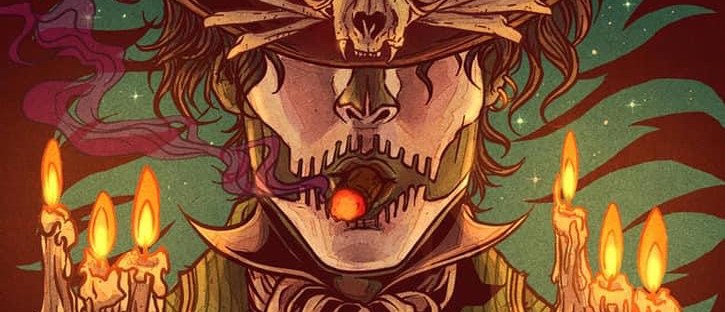
Baron Samedi is the leader of the Barons and possibly the Gedés. He presides over a sprawling, confusing, complex clan of spirits. Baron Samedi literally means Baron Saturday, which may sound innocuous compared to Baron Cemetery but a connection through Christianity is Saturday was between the crucifixion on Friday and resurrection on the Sunday. Thus,… Continue reading Voodoo Folklore: Baron Samedi
Tag: history
Breton Folklore: The Ankou
The Ankou (Breton), Ankow (Cornish) or Angau (Welsh) from Celtic legend most commonly occurs in Brittany. Here you can still spot the Ankou haunting many of the churches and cathedrals. What is the Ankou? It’s defiant remnant of Pagan influence that had survived hidden among the stone-work of Christian buildings. The Ankou haunts the graveyard… Continue reading Breton Folklore: The Ankou
Irish Folklore: Féar Gortach
The Fear Gorta means Famine Man or Féar Gortach and refers to the Hungry or Famine Grass in Irish folklore. The Famine or Hungry Man is a skeletal wraith and a harbinger of death. Féar Gortach is a folklore tale of a cursed patch of land where if you tread, you are doomed to die… Continue reading Irish Folklore: Féar Gortach
The Dearg-Due
The Dearg-Due means “red” in Irish but wasn’t the name of this poor girl during her life. In life, over two thousand years ago, she was a legendary beauty, with blood-red lips and pale blonde hair. Her true name has been lost to the ages, overshadowed instead by the thing she became. Men travelled from… Continue reading The Dearg-Due
Eros and Psyche
The myth of Eros and Psyche is probably one of the best known love stories in Greek mythology. Eros, the son of Aphrodite and personification of intense desire threw arrows to to hit a person’s heart and make them fall in love. Psyche was a beautiful maiden, who accordingly personified the human soul. She becomes… Continue reading Eros and Psyche
Blathnat: Irish Mythology
Goddess of the Tuatha de Danann Blathnat is an Irish goddess of abundance and tales of her appear in the Ulster Cycle describing her as the beautiful, scheming and unfaithful queen of the sorcerer Cu Roi. The intense love affair between Blathnat and Cuchulainn led to the death of her husband, Cu Roi. A common… Continue reading Blathnat: Irish Mythology
The Banshee
A Banshee is a fairy in Irish legend and her scream is believed to be an omen of death. The scream is also called ‘caoine’ which means ‘keening’ and is a warning that there will be an imminent death in the family. As the Irish families blended over time, it is said that each family… Continue reading The Banshee
Mirror Folklore
In folklore, a mirror is a doorway or portal through which spirits, including ghosts and demons can gain access to the physical world where demonic infestations and hauntings occur. In prehistory, any shiny surface was regarded as a spirit doorway and used to summon spirits into the world. They also are used for seeing visions… Continue reading Mirror Folklore
Dullahan
The Dullahan is a headless rider on a black horse carrying carries his own head under one arm. Usually, the Dullahan is male, but there are some female versions. The mouth of the head has a rictus grin and the eyes move constantly. The Dullahan also has the power to see across the countryside even… Continue reading Dullahan
Norse Witch: Gullveig
Gullveig is an important female figure mentioned in two stanzas in the Völuspá, one of the poems in the Nordic Poetic Edda. Her prominent role describes the events leading to the Aesir-Vanir War, the war between the two main tribes of deities in Norse mythology, the Aesir and the Vanir and the destruction of the… Continue reading Norse Witch: Gullveig

You must be logged in to post a comment.