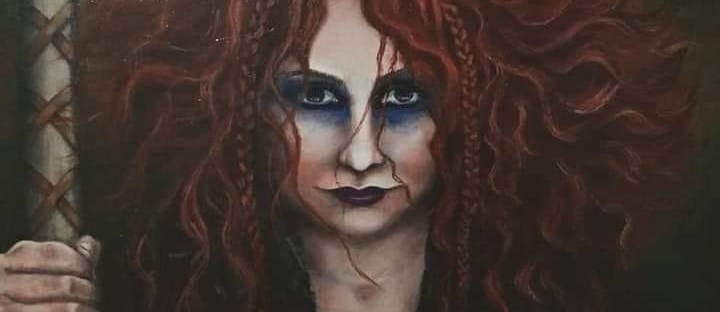
In Norwegian legend and folklore in the days before Yuletide, the Oskoreia ride through the skies. This ghostly horde of the restless dead and witches spreads terror through the wintry night sky. The Oskoreia is not dissimilar to the continental European legend of the “The Wild Hunt”. There is a common root throughout all these… Continue reading Norwegian Legend: the Oskoreia
Category: research
Irish Folklore: The Fairy Wife
Town of Tipperary - Amergin Bard “Are you a witch? Are you a Fairy? Or are you the wife of Michael Cleary?” These are the haunting lines of an Irish children’s dancing rhyme still remembered in modern Ireland today. It tells of a brutal murder, madness a strong belief in the Fair Folk. In Tipperary,… Continue reading Irish Folklore: The Fairy Wife
Slavic Folklore: Samodivi
A samodiva (plural: samodivi) is a wood nymph from the Balkans, specifically in Bulgaria. Samodiva translates ‘samo’ (alone) and ‘diva’ (wild/divine). The first part of the name signifies avoidance of humans and the second part indicates the wild or divine nature. These nymphs are forest spirits who appear as beautiful young women. But the Samodivi… Continue reading Slavic Folklore: Samodivi
Reblog:Fairy Tales to Come
The Australian Fairy Tale Society has launched many projects, events, and products, but the bones of what we do lie within the five fairy tales we … Fairy Tales to Come
Slavic Folklore: The Likho
Art - Marek Hapon The likho is part of Eastern Slavic fairy tales. Although not as frequently mentioned as the witch Baba Yaga, the likho assumes many guises from an old woman clad in black or a male goblin-like being. The common feature in both is the likho has only one eye. In the pre-Christian… Continue reading Slavic Folklore: The Likho
Norse Myth: Nidhogg
Nidhogg (Old Norse Níðhöggr, “He Who Strikes with Malice”) is one of several serpents or dragons in the Nine Worlds. The most famous serpent is Jormungand or the Midgard-serpent but Nidhogg is a dragon trapped beneath the Yggdrasil and constantly gnawing at its roots and corpses. Nidhogg is a force for chaos by destroying Yggdrasil,… Continue reading Norse Myth: Nidhogg
Greek Myth: Sirens
Funerary statue of a siren with a shell lyre, c. 370 BCE In Ancient Greek mythology, the sirens are vaguely described by various sources but are usually interpreted as being large birds with the heads of women. In the classic Ancient Greek legend The Odyssey attributed to Homer, the hero Odysseus’s ship is attacked by sirens… Continue reading Greek Myth: Sirens
Slavic Folklore: Upiór
The Upiór is present in Slavic and Turkic folklore and resembles the vampire. The Upiór is depicted as a ravenous and insatiable creature with vampiric features. Belief in the Upiór may have spread across the Eurasian steppes through migrations with its origins in the regions surrounding the Volga River and the Pontic steppes. An Upiór… Continue reading Slavic Folklore: Upiór
Slavic Folklore: Rusalka
The Rusalka is related to water-dwelling nymphs and appears in the form of a beautiful woman. Water nymphs, unlike mermaids, have legs and can walk on land. Rusalki are found in rivers or lakes they come out of the streams at certain times a year to dance and walk in the woods especially in summer… Continue reading Slavic Folklore: Rusalka
Egyptian Myth: Hathor
Hathor was known as “the Great One of Many Names” and her titles and attributes are so numerous that she was important in nearly every aspect of ancient Egyptian life and death. Her widespread worship in the Predynastic period is indicated by her depiction on the Narmer palette. During the Old Kingdom period, her worship… Continue reading Egyptian Myth: Hathor

You must be logged in to post a comment.