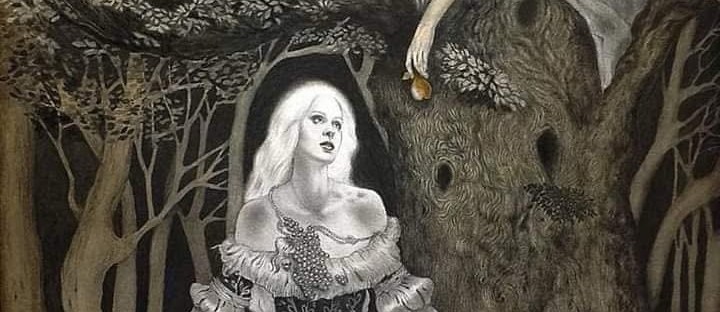
BY CHRISTINA ROSSETTI One of my favourite dark folklore infused pieces. Enjoy! 🖤 "Goblin Market" - Arthur Rackham Morning and eveningMaids heard the goblins cry:“Come buy our orchard fruits,Come buy, come buy:Apples and quinces,Lemons and oranges,Plump unpeck’d cherries,Melons and raspberries,Bloom-down-cheek’d peaches,Swart-headed mulberries,Wild free-born cranberries,Crab-apples, dewberries,Pine-apples, blackberries,Apricots, strawberries;—All ripe togetherIn summer weather,—Morns that pass by,Fair eves… Continue reading The Goblin Market
Category: research
Norse Myth: Rán
Image compiled of Rán from Pinterest In Norse mythology, Rán (Old Norse: [ˈrɒːn]) is a goddess and a personification of the sea. Rán and her husband Ægir who also personifies the sea, have nine daughters, personifications of waves. Rán apprars in the Poetic Edda and the Prose Edda, compiled during the 13th century from earlier… Continue reading Norse Myth: Rán
Ancient Greek Myth: Lamia
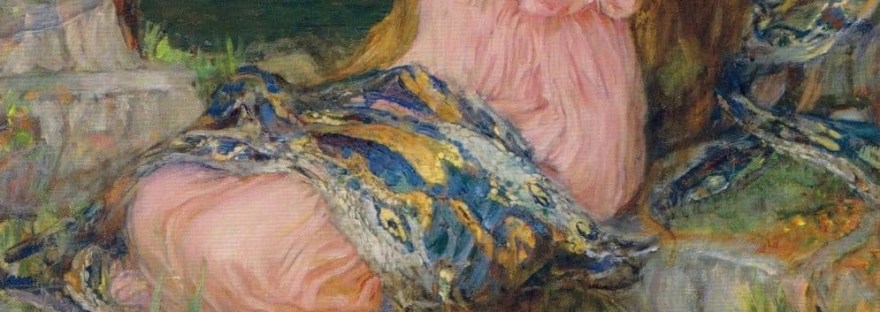
The ancient myths and legends were a source of inspiration for many of the collective literary and artists known as collectively as the Pre-Raphaelites Brotherhood. Even after several reiterations of the creative collective, interest in the ancient and medieval legends and myths remained strong. The British poet John Keats published his epic poem 'Lamia' in… Continue reading Ancient Greek Myth: Lamia
Norse Myth: The Seeress
Völva Painting by Violeta Colmenares In Norse mythology, the Norse seeress or Völva, is a prominent figure. The pre-13th Century Icelandic texts in Old Norse known as the Poetic Edda and Prose Edda respectively. The Poetic Edda contains fragmentary verse texts, while the Prose Edda is more cohesive prose text but both relate to the… Continue reading Norse Myth: The Seeress
Demon Lore: Succubi
Jordan Hanz A succubus (plural: succubi) is a demon who takes the form of a beautiful woman who in turn, seduces men. Succubi were claimed to visit men in their sleep causing erotic dreams and also nightmares. During the European witch hunt eras, those deemed succubi were thought to be agents of the Devil, tempting… Continue reading Demon Lore: Succubi
Celtic Myth: The Morrigan
In Celtic nythology, the Morrígan is a complex figure embodying war, fate, and sovereignty. She’s often depicted as a shapeshifter and appears as a crow on the battlefield to foretel doom or victory. As a goddess of war, the Morrígan decides the outcome of battles. In this role, she may bless or curse kings and… Continue reading Celtic Myth: The Morrigan
Scottish Folklore: Grey Mare of Ballachulish
The Grey Mare of Ballachulish is a haunting tale of a supernatural horse found on the moors near the village of Ballachulish, Scotland. The mare is seen on misty nights where she blends into the mist like a liminal being. If unfortunate enough to be caught on the moors during a misty night, the ghostly… Continue reading Scottish Folklore: Grey Mare of Ballachulish
Greek Myth: The Fates
The Moirai or Fates are Ancient Greek deities, three sisters who weave the destinies and lives of mortals. Clotho is responsible for spinning the thread of life; Lachesis decides on the fortune or unfortunate paths and the length of an individual’s thread of life; lastly, Atropos, chooses when an individual dies by cutting the thread… Continue reading Greek Myth: The Fates
What is Alternate History?
Pocket watch Image from Pinterest Alternate history is a term readers and writers will often come across as a sub-genre. It is a sub-genre that fascinates me and I often incorporate this into my writing. But what really does writing “alternate history” really involve? A new guide by AUS author Jack Dann The Fiction Writer’s… Continue reading What is Alternate History?
Norwegian Legend: the Oskoreia
In Norwegian legend and folklore in the days before Yuletide, the Oskoreia ride through the skies. This ghostly horde of the restless dead and witches spreads terror through the wintry night sky. The Oskoreia is not dissimilar to the continental European legend of the “The Wild Hunt”. There is a common root throughout all these… Continue reading Norwegian Legend: the Oskoreia

You must be logged in to post a comment.